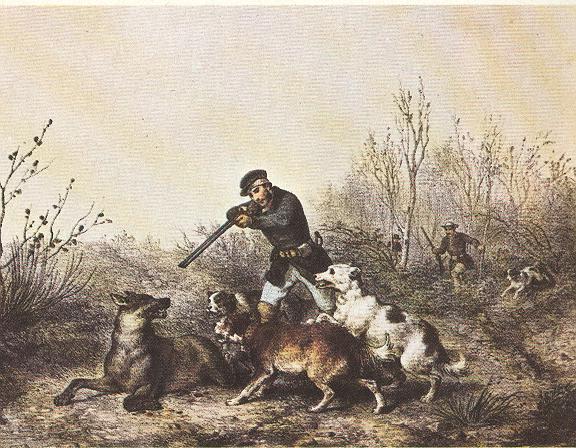
Yesterday I
attended a half-day seminar with the title "The predator-war, a journey
through times" arranged by the Swedish Forest Historical Society. Karin
Dirke from Stockholm University started with a presentation about the
historical view of the top 4 predators in Sweden (Wolf, Brown-Bear, Bobcat and
Wolverine). In the 18th century the view was that predators were greedy thieves
that committed murder. At the same time they were seen as righteous executioner
that carried out Gods verdicts. There was also a belief that men could
transform into wolves, and wolves were regarded as "A living imprint of a
human who carries on with that which is evil". The Swedish term for Werewolf
came from the word for man and wolf.
In the 18th
century media referred to wolves now and then, but they did not dominate the
news by any means. The reports consisted of methods for trapping and news about
attacks made by rabies infected wolves. These stories were usually from abroad,
and all attacks by wolves on humans were regarded as abnormal behavior, usually
connected to rabies infection. The risk of rabies spreading was seen as a
greater threat than the wolf. One news story describes how a wolf was chasing a
dog that decided to run into the house for cover. The wolf could not get in through
the door, so it jumped in through the window and bit a woman. Another woman
managed to kill the wolf with an axe. They opened up the wolf and found that
the intestines were empty, and this is given as the reason why the wolf
attacked. Another factors that is used to describe why wolves attack is extreme
cold. The message is that this is not a natural behavior.
A
conservation perspective starts to slowly appear in the 19th century. It is through a nationalistic touch that praises the diversity of this wide-stretched nation, and the
wolf is seen as belonging to the Swedish fauna. Until then the political view
had been that the wolf should be exterminated from Sweden or driven to the
borders of the nation. The view of Brown-Bears was not at all as negative as
that of wolves, probably because that they were not seen as full predators.
After Karin
Dirke, Kjell Donell and Roger Bergstam from The Agricultural University in
Uppsala described the war against predators that started already as the ice
retreated to 1969 when the last one of the big four predators (The wolverine)
became protected. In 17th century Sweden historical texts state that predators
should be exterminated wherever, whenever, however and by whom ever.
The public was forced to participate in the hunt for predators, and refusal resulted in fines or prison. The mandatory hunts were strongly connected to holidays, and the last day of the holiday was the day of the mandatory hunt. The reward for participating was bag-money, high status, skins and reduced predator populations. An example was Herman Falk, a hunt-master appointed by the king, who alone killed more than 100 bears. He is also regarded as having saved the moose population by recommending the king to install a 10 year ban on moose-hunting at a time when the moose-population was almost extinct.
The way to receive
bag-money was far from straight-forward and a skin would have to be presented
to 3-4 courts before the bag-money could be paid to the hunter. This resulted
in that it could take more than a year to receive the payment. Converted into the
monetary value in 2009, the bag money in US$ was $71 for a brown-bear, $53 for
a bobcat, $35 for a wolf and $18 for a wolverine. Outside the big four, the bag
money was $6 for a fox as well as for eagle and $3 for a European Pine Marten.
The penalty for not participating ranged from fines to time in prison with only bread and water. Those employed by the state to hunt predators could get reduced salary if they failed to fill a certain quota of predators. If a state employed hunter had problems filling a quota of a specific animal due to that the region for example had few wolves, he could compensate this by shooting x numbers of another predator following an exchange rate. The penalty system was constructed so that the cost for the state would be minimal, which meant that reduced salaries from state employed hunters went to finance bag-money.
The methods
used to hunt predators included an enclosed area with baits inside. The enclosed area was also surrounded by a ditch. The walls were leaning inwards allowing wolves to jump in, but prevented them from coming out. When a flock of wolves had come into the area, farmers could climb the walls and shoot the wolves. Other
methods included a large group of people driving wolves towards a net, wolf
pits, use of poisoned baits (Arsenic and Strychnine were often used), slip knots, scissor traps, log or stone traps, self-shooting
weapons that fired when a bait was touched.

Sweden contributed with a very cruel
method that in North America became known as the Swedish Method. The method
focused on concentrating the effort to the breeding place. At the den all wolves
that could be seen were killed except one wolf-pup which was hung upside down
in a nearby tree. This lured out any other wolves in the family that might be
nearby. After that the young wolf-pup was killed as well.
Another
gruesome method included feeding a dog with Arsenic, and later putting it out
for wolves to feed on. The amount of poison was regarded as enough, when the
dog started losing its fur. The dog was then strangled and put as bait to wolves.
The reason for strangling the dog instead of any other method was to save as much
of the mercury loaded blood.
Everybody
was supposed to have a wolf-net at home that had a certain length and strength.
Regular inspections were done, and if a farmer's wolf-net broke when the strength
was tested he could be fined.
The efficiency
of many methods were poor. Driving a predator towards a net took 600 man-work-days/predator,
were the term man-work-days referred to the amount of work one man could do in
one day. For wolves the efficiency was 286 man-work-days /wolf. A wolf-pit had
the terrible efficiency of 1 wolf/20 years, whereas a poisoned dog was reported
to have an efficiency of 13 wolves and 1 bob-cat.
The result
of this war on predators was very successful, with all of the big four
predators having their populations severely reduced. Around 1830 the numbers of
shot wolves were between 650-700 per year, but 40 years later the number was
down to 50 wolves per year.
With the
last of the big four predators, the wolverine, being protected from hunting in
1969 the large state supported war on predators could be said to have come to a
stop, although it had since long lost in intensity with people no longer being
forced to participate in hunts.
Since then
all the big four predators have seen increased population-numbers, and new conflicts between humans and predators have emerged. Hopefully
we have learned from the past, and will try to solve conflicts where they occur
before chasing every man and woman out of the house for mandatory predatory
hunts in a forest filled with self-shooting weapons, monstrous traps and a fair amount of Arsenic and Strychnine.

No comments:
Post a Comment